
If something comes out of the anus… it’s not always Hemorrhoids.
Many people with rectal prolapse have spent years believing that what they were experiencing was simply Hemorrhoids.
Until one day they notice that what comes out no longer goes in so easily.
Or they feel that evacuating costs more.
Or they start to make losses.
And there they realize that there is something more.
Something that cannot be fixed with creams or sitz baths.
Rectal prolapse is not a common condition, and that’s precisely why many professionals don’t know how to properly diagnose it.
But a misdiagnosis or an ill-prescribed surgery can worsen the problem… or cause damage that’s difficult to reverse.
That’s why at ProctoPelvis, we believe in listening, assessing, and planning.
I’ve worked in leading pelvic floor units in the United Kingdom, where I conducted a study interviewing women who underwent rectal prolapse surgery.
That work helped me understand what they need, what they fear, and what they expect from a surgery like this.
And since then, it’s been clear to me: this type of problem isn’t treated with a scalpel alone.
It’s treated with judgment, listening, and clear explanations.
Because not all prolapses are the same.
And depending on where it originates (how high in the rectum and which structures are involved), a different surgical technique must be chosen.
But that’s not always the case.
Many surgeons have only one tool in their arsenal.
And you know how it goes:
If all you have are hammers, everything looks like a nail.
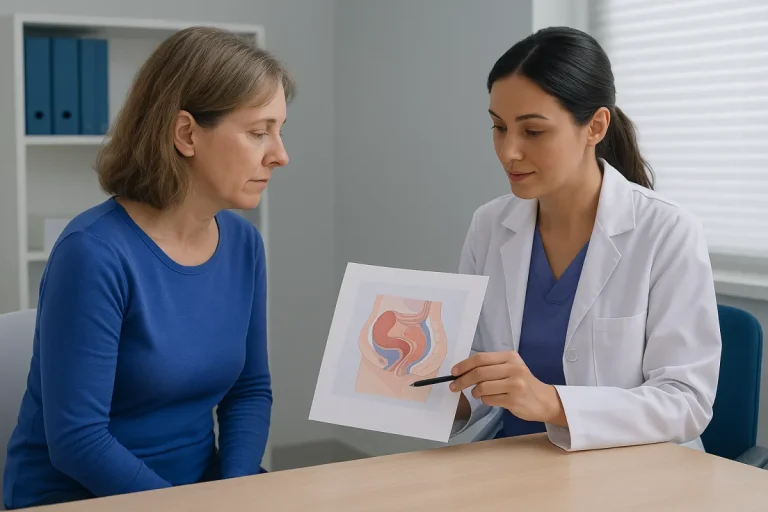
We choose the most appropriate surgical technique for you based on:
Depending on your age, the condition of your pelvic floor, the characteristics of your prolapse, and your priorities, we can perform surgery via the abdominal approach (such as laparoscopic ventral rectopexy) or via the perineal approach (through the anus).
At ProctoPelvis, we don’t always use the same technique. The important thing is to choose the procedure that best suits your case and your life.
Timely surgery is also important.
The longer the prolapse remains out, the weaker the sphincter becomes, and the more difficult it can be to regain control.
Therefore, it’s not just a matter of “waiting until it gets more severe.”
It’s about assessing when the right time to intervene is, before it leaves any lasting effects.
To ensure long-lasting results, we also work on:
You should consider a consultation if:
Address: Vía de las Dos Castillas 9A, Pozuelo de Alarcón, Madrid 28224
Email: info@proctopelvis.com
WhatsApp: +34623781848
Hours:
Monday – Friday 10am to 2pm
Tuesday – 10am to 7pm
Saturday and Sunday – Closed